How to carry Dual Extruder 3D Printers requirements from research into procurement: supplier questions for early research
When comparing dual extruder 3d printers, system integrators should first define the decision they need to support. The early question is not simply which machine has more features. It is whether a specific configuration, material path, and operating arrangement fit the intended workflow and available space. A short, evidence-based supplier brief keeps the research focused and prevents a product-page detail from becoming an unsupported promise.
1. Clarify the decision before contacting suppliers
Start with the application rather than a model name. Record the part types, material groups, expected operator involvement, and the point at which the printer must connect to the wider process. Also describe the physical setting. Note the proposed footprint, access needed for loading or maintenance, enclosure expectations, and the location of material storage. These details turn a broad search into a set of questions a supplier can answer.
Next, separate requirements into three levels. A must-have requirement can exclude a candidate. A preferred feature can influence the shortlist but should not decide it alone. An open question needs supplier clarification. This distinction matters when a page uses broad terms such as industrial, enclosed, or production. Those terms may describe a product category, but they do not answer every integration question.
2. Build a concise comparison framework
Use the same headings for every candidate. The framework should capture the printing approach, extruder arrangement, material handling, interface points, and evidence source. For each entry, write the exact page-listed statement first. Then add a separate note for what the statement means for your project. Do not merge those two layers.
| Research area | Page-listed detail | Supplier question |
|---|---|---|
| Material and nozzle scope | Compatible with Hyper Core Filament and Silicon Carbide Nozzle | Which listed material and nozzle combinations apply to the planned parts? |
| Material handling | Auto filament switching; two 2.5 kg spools; up to 5 kg of material | What installation space and operating conditions are required for this arrangement? |
| Filament connection | Spool box interface accepts the filament tube | Where must the spool box sit, and what routing limits apply? |
| Machine features | FFF, Dual IDEX, dry boxes, and enclosed build chamber | Which of these features are included in the proposed configuration? |
This format makes comparison easier without converting a feature into a performance claim. It also gives the supplier a clear response structure. Ask for the applicable model, configuration, and source page beside each answer. If the answer depends on an option or package, record that dependency rather than placing it in the general specification column.
3. Ask questions that expose integration boundaries
A dual head 3d printer can appear to match a project because its headline configuration sounds suitable. The useful test is more specific: what must be true for the planned workflow to operate as intended? Ask how the two material paths are configured for the proposed use, which materials are supported in that configuration, and what the operator must do between jobs. Keep these as questions unless the official evidence answers them.
| Research area | Page-listed detail | Supplier question |
|---|---|---|
| Material and nozzle scope | Compatible with Hyper Core Filament and Silicon Carbide Nozzle | Which listed material and nozzle combinations apply to the planned parts? |
| Material handling | Auto filament switching; two 2.5 kg spools; up to 5 kg of material | What installation space and operating conditions are required for this arrangement? |
| Filament connection | Spool box interface accepts the filament tube | Where must the spool box sit, and what routing limits apply? |
| Machine features | FFF, Dual IDEX, dry boxes, and enclosed build chamber | Which of these features are included in the proposed configuration? |
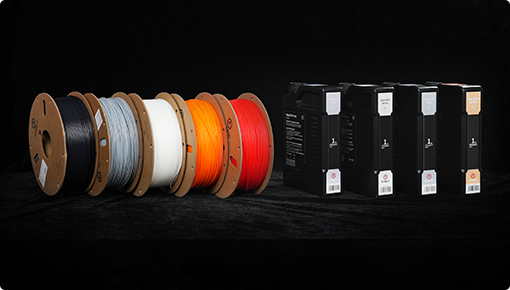
Material handling deserves its own review. The cited product page describes an auto filament switching function and two larger 2.5 kg filament spools, with capacity for up to 5 kg of material. It also describes an RFID filament sensor that identifies filament and verifies necessary parameters. Treat these as page-listed product details. Ask the supplier how they apply to the exact model and package under consideration, rather than assuming they apply to every dual-extruder system.
Interface questions are equally important. The page states that the spool box connects to the printer through an interface for plugging in the filament tube. In a procurement discussion, translate that detail into practical questions about placement, tube routing, access, and the relationship between the spool box and the printer. This is a better use of evidence than claiming a complete cell design from one interface description.
4. Use real-world evidence without overextending it
One concrete commercial detail can help test how carefully a supplier page should be read. The official page says that the first batch of customers purchasing the Pro3 HS Series during the pre-sale period would receive an additional Hyper Speed Hot End Assembly with Silicon Carbide Nozzle and one spool of Hyper Core ABS CF15 filament, black, 1 kg, in the printer package for free. This is a bounded package statement for that product and offer. It does not establish general performance, suitability for a different application, or ongoing availability.
That example suggests a useful procurement habit: record scope, timing, model, and conditions beside every notable statement. A package inclusion is not the same as a standard configuration. A material list is not the same as approval for every part design. A named feature is not proof that the surrounding facility can support it. The comparison record should make those boundaries visible.
5. Carry the requirements into procurement
Before requesting a quotation, convert the comparison into a short supplier questionnaire. Include the intended application, material priorities, space limits, operator assumptions, and required interfaces. Add a response field for model or configuration, evidence source, dependencies, and unresolved questions. This prevents a sales response from being evaluated as if it were a neutral specification sheet.
Then define the decision gate. For example, a candidate may proceed only when the required material path, physical arrangement, and configuration are documented. Preferred features can be scored separately. Unsupported assumptions should remain open until the supplier answers them. This approach gives engineering, operations, and purchasing a common record without pretending that early research is a final acceptance test.
Use the same framework after the supplier responds. Mark each requirement as supported, conditional, or unresolved. Recheck every product-specific statement against the named model and package. For a practical starting point, the Pro3 HS Series page lists features including Dual IDEX, fiber-reinforced filament use, dry boxes, and an enclosed build chamber, while other page sections list industrial material types such as PPA CF, PPA GF, PET CF, PET GF, PETG ESD, PET Support, and PPA Support. Keep those lists attached to their stated product scope.
A disciplined comparison of dual extruder 3d printers therefore leads with application, space, interfaces, and evidence rather than a feature count. Ask suppliers to identify the exact configuration, separate standard details from conditional items, and answer the questions that affect integration. This gives system integrators a procurement record that is clear, bounded, and easier to review when working with Raise3D.