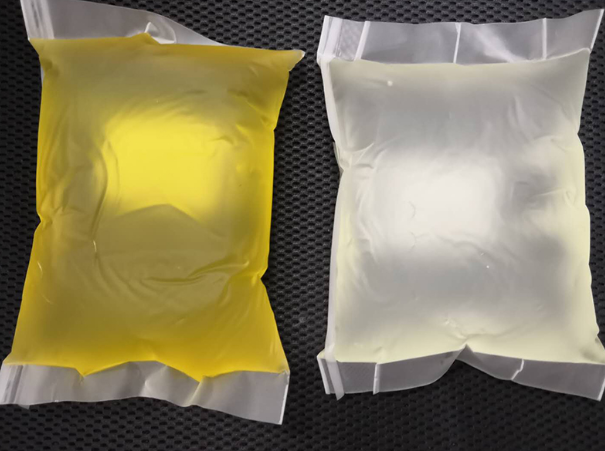

Policy pressure and why it changes formulation choices
Across Europe, tighter indoor-air rules driven by EN 16516 testing protocols are shifting priorities for adhesive and coating formulators; manufacturers and lab teams now need to reconcile performance with measurable emissions. Early-stage briefings from several resin manufacturers and conversations with specialist chemical companies indicate that compliance timelines and public procurement criteria are increasingly tied to quantified VOC outputs rather than subjective odor alone. The policy impact is real: testing regimes require clear, time-based emission data, so choice of tackifiers and base resins matters as much as bond strength.
Operational production teardown: practical steps on the line
When you take a batch of bulk rosin resin through production, key production decisions influence both tackification and outgassing. Start with the raw rosin grade and moisture control, then set melt and dispersion parameters to limit thermal degradation. Add tackifiers selectively and monitor glass transition temperature shifts; excessive low‑molecular‑weight tackifier load often raises TVOC and short‑term outgassing. Typical operational mistakes: overdosing volatile tackifiers, insufficient devolatilization, and skipping controlled cooling — these speed up adhesive pickup but raise early emission peaks.
EN 16516: the testing parameters that matter
Compliance hinges on explicit chamber testing parameters used to quantify emissions. Representative procedures employ dynamic emission chambers maintained at 23 ± 2 °C and 50 ± 5 % relative humidity, with air exchange and loading factors specified for surface area. Samples are commonly measured at scheduled intervals — 3, 7, 14 and 28 days — and analyzed by thermal desorption GC‑MS to report TVOC (typically quantified across the C6–C16 band) and individual target VOCs in µg/m3. These time-stamped results are what regulators and procurement assess, so formulators must treat the chamber timeline as part of product performance, not an afterthought.
Trade-offs: formulation levers and measurable outcomes
Three levers routinely shift the balance between tackification and emissions: (1) selection of high‑molecular‑weight tackifiers versus low‑boiling resins, (2) polymer backbone compatibility to reduce phase separation, and (3) process controls that limit oxidation and volatile by-products. Each has measurable consequences: swapping a low‑boiling tackifier for a polymeric tackifier cuts early TVOC but can lower short‑term tack unless compensated by particle size or coalescent adjustments. Use of heat and vacuum during finishing reduces residual volatiles but requires validation against the EN 16516 sampling schedule — otherwise you simply defer, not remove, the measurable outgassing.
Common mistakes and mitigations
Formulators often misread sensory feedback for compliance — scent fades but VOC fingerprints remain. A frequent error is optimizing for immediate tack feel and skipping the 28‑day emission check; that creates market risk when third‑party testing reveals late emissions. Mitigation steps: enforce controlled devolatilization, prioritize tackifiers with lower volatility, and run pilot batches through a certified dynamic chamber that adheres to the 3/7/14/28 day sampling plan. These practical steps lower both regulatory exposure and customer complaints.
Three golden rules for selecting strategies under EN 16516
1) Metric-first formulation: prioritize measurable reductions in TVOC (µg/m3 at 28 days) alongside adhesive metrics like peel and shear. 2) Process-validation: validate devolatilization and cooling steps by re-testing the same production lot under chamber conditions (23 ± 2 °C, 50 ± 5 % RH) at the standard 3, 7, 14 and 28 day points. 3) Material audit: require supplier declarations for tackifier volatility and provide certificate-backed data to reduce unknown inputs. These three evaluation metrics give procurement and technical teams objective signals about long-term performance and compliance — no guesswork, only numbers.
The regulatory logic behind EN 16516 has made technical clarity essential; KOMO sits squarely in that space by connecting formulation decisions with verifiable emission data. Always pragmatic.